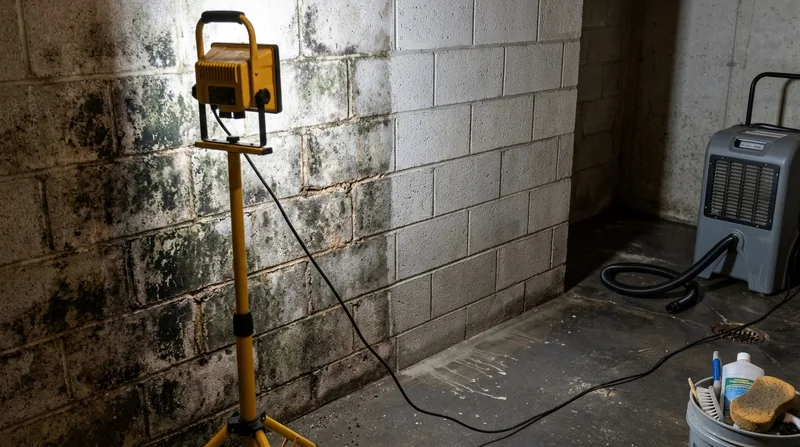




If you smell that earthy, musty odor every time you walk down the basement stairs, you are not imagining it. Basement mold remediation in Evansville starts with finding the water source, not with spraying bleach on the wall. In Jacobsville and the older east side, 1890s to 1930s brick and stone foundations wick groundwater all spring, and along the Ohio River and Pigeon Creek the water table sits close enough to the footing that damp never really leaves. The loess silt uplands and glacial clay soil hold rain against the wall instead of draining it away. We treat the mold, then we fix the moisture path so it does not come back. Our basement waterproofing service is usually where the permanent fix lives.
Why Basement Mold Grows Fast in Evansville Foundations
Evansville runs humid summers, mild winters with hard freeze-thaw swings, and spring storms that dump two inches in an afternoon. Old brick and early block walls in Oak Hill and Bel Air soak that water up like a sponge. It moves through the mortar and evaporates inside the basement, raising relative humidity above 60 percent, and that is when mold colonizes joists, drywall, boxes, and stored furniture. Poured-concrete basements in the newer north and east subdivisions grow mold too, usually after a sump pump fails or a downspout dumps water at the corner.
- Efflorescence and white salt bloom on the wall mean water is actively moving through the masonry.
- A musty smell with no visible stain usually points to damp framing or a failed vapor barrier under the slab.
- Mold in the same corner after every heavy rain is a hydrostatic pressure problem, not a cleaning problem.
- High humidity in a closed basement feeds surface mold on joists and rim boards even without a puddle.
Each of these points to a different moisture source, and the remediation plan has to match the source.
Key info: A 1920s brick basement near Pigeon Creek in Jacobsville can grow mold on the sill plate every June from nothing more than river-valley humidity and a missing vapor barrier. A 1990s poured wall in Chandler with mold at the baseboard usually has a failed sump pump or a short discharge line dumping water back at the foundation.
Indiana code and local building rules on drainage and structural repair are enforced by the local building department, and you can verify current requirements through the Indiana Department of Homeland Security and the City of Evansville building department before any drainage work is altered.
How We Run Mold Remediation in Evansville Basements
We work in a fixed order because skipping steps is how mold comes back. First we find the moisture, then we contain the work area, then we remove and treat, then we dry the space, and finally we correct the water path. The last step is the one that matters five years from now.
- We walk the basement and the exterior grade, checking wall seepage, efflorescence, the sump basin, and the discharge line.
- We meter the framing and drywall to map the wet zone and confirm the moisture source before we cut anything.
- We set poly containment and negative air pressure so spores do not migrate into the living space upstairs.
- We remove porous materials that cannot be cleaned, then treat structural surfaces with an approved antimicrobial.
- We dry the space with dehumidification and air movement until framing moisture reads normal.
- We correct the source with drainage, sealing, or a vapor barrier, and we confirm the repair holds through the next rain.
Containment and drying are not optional steps, because a treated wall that stays damp will grow mold again within a season.
Key info: On a 1950s Cape Cod in Oak Hill, we found mold on the bottom two feet of drywall from a cracked block wall taking hydrostatic pressure. We removed the affected drywall, treated the block, and tied the wall into an interior drain tile system so the pressure relieved to a sump basin instead of the wall.
Remediation and Moisture Control Approaches We Use
Not every basement needs the same fix. A single damp corner with surface mold is a different job from a wall that weeps after every storm. The table below shows the approaches we use and where each one fits.
| Approach | Description | Best for |
|---|---|---|
| Surface treatment and containment | Contain the area, remove porous material, treat framing and masonry with antimicrobial. | Surface mold on joists, rim boards, and stored goods with no active water entry. |
| Dehumidification and vapor barrier | Dry the space, then seal the slab and wall with a vapor barrier and dimple board. | High humidity and musty smell with no visible puddle, common in river-valley basements. |
| Interior drain tile plus sump | Cut an interior perimeter drain to a sump basin and pump, relieving hydrostatic pressure. | Walls that weep after every storm and mold that returns at the baseboard. |
| Crack injection and wall sealing | Epoxy or polyurethane injection into cracks, plus parging and wall sealing to stop seepage. | Isolated poured-wall cracks and damp masonry with no perimeter water problem. |
| Grading and discharge correction | Regrade soil away from the wall and extend downspouts and sump discharge well clear. | Mold concentrated at one corner where roof water and pump discharge land. |
We choose the lightest approach that actually solves the moisture source, because overbuilding a small problem wastes money and underbuilding a big one wastes a season.
Basement Mold Remediation Cost in Evansville: What to Expect
Remediation in Evansville starts around $1,500 for a contained single-room job with surface treatment and drying. From there the number climbs with square footage, how much drywall and insulation has to come out, and whether the moisture fix is included. A basement that needs an interior drain tile system and a sump pump is a different budget than one that needs treatment and a dehumidifier. Our full pricing overview breaks down the ranges by scope.
- Affected square footage drives material removal and disposal cost more than anything else.
- Access matters: a narrow 1890s stair in Jacobsville slows containment and haul-out compared with a walkout in Newburgh.
- Whether the moisture source fix is bundled in changes the total significantly, and skipping it usually means paying twice.
- Testing and clearance checks add a line item when the scope calls for them.
Get two or three written estimates on the same scope, and make sure each one states whether the water source correction is included or billed separately.
Choosing a Basement Mold Remediation Contractor Near Me in Evansville
Mold work and moisture work should come from the same crew, because a remediator who does not fix water will be back next spring. Ask for proof of licensing and insurance, and ask whether the estimate includes the drainage or sealing correction. Call references from basements built like yours, brick or poured. Check whether permits are needed for any structural or drainage alteration, and confirm the local building department's current rules before work starts. If you are in a historic district or an HOA, check those requirements before cutting anything. Reach us through the contact page to set up an inspection.
Ask one direct question of every contractor: what is the water source, and what are you doing about it? A crew that cannot answer that in plain language is guessing.
Basement Mold Remediation in Evansville: Pricing Guide
| Service | Price | Details |
|---|---|---|
| Contained single-room treatment | Starting at $1,500 | Includes containment, antimicrobial treatment, and drying for one affected basement room with surface mold. |
| Full basement remediation | Starting at $3,200 | Covers larger affected square footage, removal of porous materials, HEPA filtration, and full drying. |
| Remediation plus moisture source fix | On estimate | Bundles treatment with drain tile, crack injection, or vapor barrier, priced after the water path is confirmed. |
| Musty smell diagnostic | Included | Moisture mapping of framing, slab, and wall base to locate the source before any treatment is quoted. |
| Travel | Included | In Evansville and surrounding areas, no separate call-out or mileage fee. |
| Estimate | Free | Response within 24h at (812) 461-1167, no obligation to book. |
Indicative pricing, the exact cost depends on square footage, finish, and site access. Free personalized estimate within 24h at (812) 461-1167.


