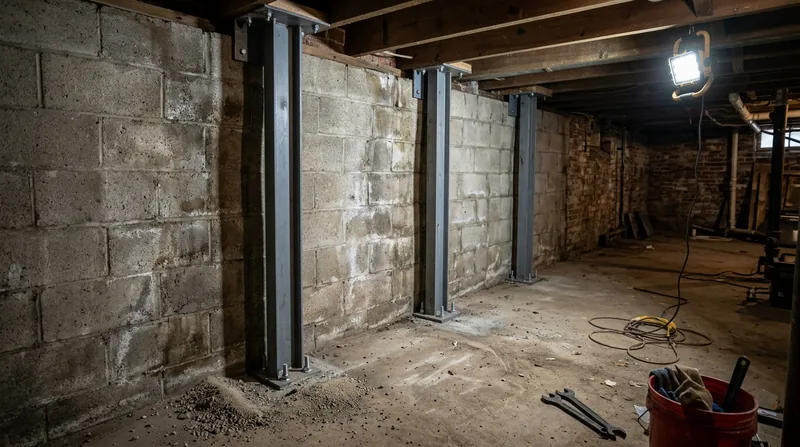




If you own an older home in Jacobsville, Downtown Evansville, or along the older east side, you already know what Ohio River silt and clay can do to a brick or block basement wall. Bowing Wall Repair in Evansville is the work of stopping that inward lean before the wall fails. The ground here is river silt and glacial clay, and it holds water tight against the foundation. Spring rains and summer thunderstorms push the water table up, and that wet clay presses hard on walls that were laid up a century ago. We read the crack pattern, the plumb of the wall, and the soil load, then match carbon fiber straps, steel I-beams, or wall anchors to the severity of the movement. If your wall is already leaning, call foundation crack repair only after the bow is stabilized, because sealing a crack in a moving wall is wasted money.
Why Bowing Walls Are Common in Evansville's Older Basements
Most of the bowing walls we see sit in 1890s to 1930s brick and stone basements, and in 1930s to 1960s block walls in Oak Hill and Bel Air. Those walls were built to hold back soil, not saturated clay under hydrostatic pressure. The loess silt on the uplands and the river silt near Pigeon Creek both swell when wet, and the freeze-thaw swings of a southern Indiana winter work the joints loose. Once the wall starts to move, the movement rarely stops on its own.
- Brick and stone walls in Jacobsville and Downtown show stair-step cracking and efflorescence as water pushes through the mortar.
- Early block walls in Oak Hill and Bel Air develop horizontal cracks at mid-height when the clay load exceeds what the block can carry.
- Poured-concrete basements in the newer north and east subdivisions bow at the form ties when the footing drain clogs and water stacks up.
- Low lots near the Ohio River hold the water table close to the surface, so the wall stays wet and the pressure never really drops.
Any one of these signs means the wall is telling you the soil load has changed, and it is worth a look before the next wet spring.
Key info: A block wall in Oak Hill that shows a horizontal crack at mid-height is not the same problem as a hairline crack at a corner. The horizontal crack means the wall is bowing under load, and it needs straps or anchors, not a tube of sealant.
For the official word on structural repair permits in the city, check the City of Evansville building department before any wall work begins, because the rules and inspection thresholds are set locally.
How We Diagnose and Stabilize a Bowing Wall in Evansville
We start by finding out what is actually moving the wall. That means checking the plumb with a level, mapping the crack pattern, and reading the soil and drainage around the foundation. A wall that bows because the footing drain is dead needs the drainage fixed along with the wall. A wall that bows because the clay is simply loaded against it needs structural restraint. We do not sell anchors to a wall that only needs a crack sealed, and we do not seal a wall that is still moving.
- We inspect the wall, the footing, and the grade around the foundation, and we note where water is standing after a rain.
- We measure the bow at its worst point and record the crack widths so the repair can be matched to the actual movement.
- We set carbon fiber straps on block and concrete walls where the bow is moderate and the wall is still sound.
- We install steel I-beams on walls with heavier load or deeper movement, anchored into the footing and the floor framing.
- We drive wall anchors through the soil to the outside of the wall where the clay load is the main driver and the wall can be pulled back to plumb.
- We restore the drainage that let the water build up in the first place, so the repaired wall is not fighting the same load again.
The method follows the wall, not the other way around, and the repair is only as good as the drainage that supports it.
Key info: On a 1950s block basement in Bel Air, the wall had bowed about 1.5 inches at mid-height and the footing drain was full of clay. We set carbon fiber straps across the wall and cleared the drain line, and the wall has held plumb through three wet springs since.
When the bow is paired with water coming through the wall, the drainage side is handled through interior drain tile so the wall is not carrying the water table alone. For homes in the 47711 ZIP code, our Evansville bowing wall repair page covers the local block and brick conditions in more detail.
Repair Methods We Match to Evansville Walls
No single method fits every wall. The right call depends on the wall material, the amount of bow, and how much clay load the soil is putting on the foundation. Here is how the main approaches compare in the field.
| Approach | Description | Best for |
|---|---|---|
| Carbon fiber straps | Straps bonded vertically to the wall and anchored top and bottom to stop further movement. | Moderate bow on block and poured walls that are still structurally sound. |
| Steel I-beams | Beams set against the wall and tied into the footing and floor framing to carry the load. | Heavier bow or deep movement where the wall needs real structural restraint. |
| Wall anchors | Anchors driven through the soil and connected to the wall to pull it back toward plumb. | Walls pushed by saturated clay where the outside soil can be reached. |
| Drainage correction | Clearing or replacing the footing drain and regrading so water stops loading the wall. | Walls that bow because the drain is dead and water stacks up behind them. |
The structural repair and the drainage fix usually go together, because a wall that stays wet will keep moving no matter how it is braced.
Bowing Wall Repair Cost in Evansville: What to Expect
Pricing for bowing wall repair starts at $600 for a small, localized fix such as a single strap run or a short section of drainage correction. Most real bowing jobs run higher, because the wall has to be stabilized along its length and the drainage has to be restored. The number moves with the wall material, the amount of bow, the number of straps or beams, and how much excavation the anchors require. Getting two or three estimates is smart, and so is asking each contractor to explain the method they would use and why.
- Wall length and the number of straps, beams, or anchors drive the bulk of the cost.
- Brick and stone walls in Jacobsville take more time than poured walls because the mortar joints have to be worked around.
- Anchor work needs access to the outside soil, so a tight lot near Downtown adds labor.
- Drainage correction adds cost, but skipping it means the wall keeps fighting the same water load.
We put the full range of options on our pricing page so you can compare before anyone walks the basement.
Hiring a Bowing Wall Repair Contractor Near Me in Evansville
Bowing wall repair is structural work, and the contractor you hire should be able to explain the method, show proof of insurance, and tell you what the local building department will require. Ask for references from jobs in Evansville and the surrounding towns, and ask whether the company carries general liability and workers' compensation coverage. A contractor who cannot produce a certificate is a risk you do not need on a foundation wall.
- Confirm the company is licensed and insured, and ask for the certificate before work starts.
- Get two or three written estimates that name the method and the drainage work included.
- Ask for references from block and brick basement jobs in Evansville and nearby towns.
- Check with the local building department on permit requirements for structural foundation repair.
- Ask how the company handles HOA rules if your subdivision has them.
When you are ready to have the wall looked at, reach out through our contact page and we will set up a time to walk the basement with you.
Bowing Wall Repair in Evansville: Pricing Guide
| Service | Price | Details |
|---|---|---|
| Carbon fiber strap repair | Starting at $600 | Covers a small localized strap run, with wall length and number of straps moving the price |
| Steel I-beam installation | Starting at $1,800 | Includes beam set and footing tie-in, with wall length and access driving the cost |
| Wall anchor system | Starting at $2,400 | Covers anchors and outside excavation, with soil access and wall length as the main factors |
| Drainage correction add-on | Starting at $900 | Clears or replaces the footing drain so the repaired wall stops fighting water load |
| Complex or large-scale job | On estimate | Multi-wall bowing or heavy clay load needs an on-site look before any number is given |
| Estimate | Free | Response within 24h at (812) 461-1167, with no obligation to book the work |
Indicative pricing, the exact cost depends on square footage, finish, and site access. Free personalized estimate within 24h at (812) 461-1167.


