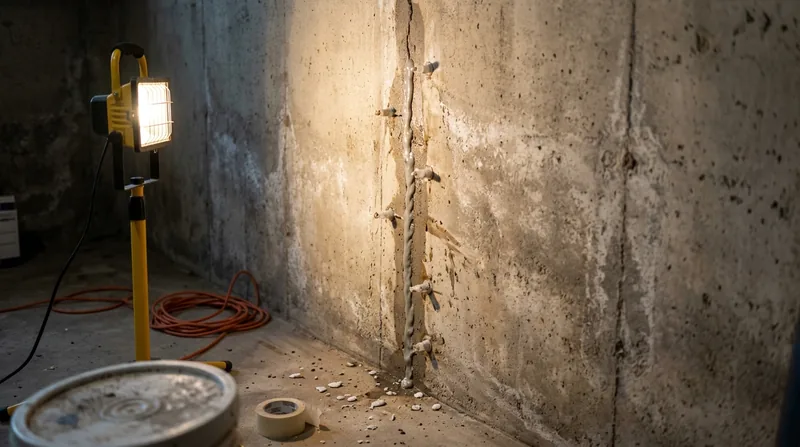




Foundation crack repair in Evansville starts with reading the ground, not the crack. This city sits on Ohio River silt and clay over glacial deposits, with loess silt on the uplands, and that soil moves with every wet spring and freeze-thaw swing. In Jacobsville and the older east side, full basements of brick and early block were laid before modern drainage, so a hairline in the mortar can be the first sign of water finding its way in. North side subdivisions built from the 1970s on have poured walls, and those cracks behave differently. We inspect the crack, the wall, and the water table around it before we recommend a method. If you are also dealing with wet basement symptoms, start with our basement waterproofing service page to see how crack repair fits the bigger picture.
Why Evansville Foundations Crack the Way They Do
The dominant failure here is not one dramatic event. It is the slow push of hydrostatic pressure from saturated silt and clay against a wall that was never designed for it. Low lots near the Ohio River and Pigeon Creek hold groundwater close to the surface, and the 1937 flood still shapes how the riverfront is built. Upland homes in Oak Hill and Bel Air sit on loess, which drains fast at the surface but shifts when it stays wet. Cracks show up as vertical shrinkage cracks in poured walls, stair-step cracks in block, and horizontal hairline seams in old brick.
- Spring rains and heavy summer thunderstorms push water toward old foundations and open existing cracks wider.
- Freeze-thaw cycles in mild Evansville winters work mortar joints loose on 1890s-1930s brick walls.
- Uneven settling on glacial clay soil opens diagonal cracks near corners and window openings.
- Clogged footing drains and short downspouts concentrate water at the exact spot where a crack already exists.
Every one of those patterns points to a different repair method, which is why we match the fix to the crack instead of sealing everything the same way.
Key info: A 1920s brick basement in Jacobsville with a stair-step crack near the corner is usually a different job than a 1990s poured wall in a north-side subdivision with a clean vertical shrinkage crack. Same city, different water, different repair.
Structural foundation repair permits are commonly required in this region, and the local building department sets the thresholds. Verify the current rules with the City of Evansville before any structural work begins: City of Evansville government offices.
How We Repair a Foundation Crack in Evansville, Step by Step
We start by finding out whether the crack is letting water in or whether the wall is moving. Those are two different problems, and treating a moving wall with injection alone wastes money. Our first visit is a free basement inspection, where we check the crack width, look for efflorescence and rust staining, test for moisture, and note the grading and downspout discharge outside. Then we choose the method and explain why.
- We clean the crack and drill injection ports at the angles the wall material calls for.
- We flush the crack with water or air to confirm it is open and free of debris.
- We inject epoxy for structural cracks or polyurethane for active leaks, depending on the diagnosis.
- We seal the surface, remove the ports, and check the repair under pressure before we leave.
- If the crack is wide, shifting, or paired with a bowing wall, we discuss carbon fiber straps or wall anchors instead of injection alone.
That sequence keeps a simple repair simple and flags the jobs that need more than a patch.
Key info: On a Cape Cod in Oak Hill with a wet vertical crack after a June storm, we typically use polyurethane injection because the crack is active. On a poured wall in a newer east-side subdivision where the crack is dry and stable, epoxy injection restores the wall section without chasing water that is not there.
If the inspection shows water coming through the wall-to-floor joint rather than the crack itself, the answer is usually drainage, not injection. Our interior drain tile system page explains that path.
Repair Methods We Use and When Each One Fits
No single method covers every crack in Evansville. The table below shows how we match the approach to the wall material, the crack pattern, and whether water is currently moving through it. We explain the reasoning on site so you can see why one method costs more than another.
| Approach | Description | Best for |
|---|---|---|
| Epoxy injection | Ports drilled along the crack, epoxy injected to bond the concrete back together. | Dry, stable vertical or diagonal cracks in poured walls. |
| Polyurethane injection | Flexible foam expands and seals the crack while it is actively leaking. | Wet, active cracks and wall-to-floor joints. |
| Carbon fiber straps | Straps bonded to the wall to resist inward movement. | Cracks paired with early bowing in block or poured walls. |
| Wall anchors | Anchors driven into stable soil outside and tied to the wall inside. | Walls that have moved and need to be pulled back. |
| Surface sealing and parging | Crack cleaned and sealed with a flexible membrane on the interior face. | Minor non-structural cracks in old brick or block. |
The method decision is the whole job. Getting it wrong means paying twice.
Foundation Crack Repair Cost in Evansville: What to Expect
Most single-crack injections in Evansville start around $450, and that figure covers the inspection, port installation, injection material, and cleanup for a straightforward vertical crack. The price moves up with crack length, wall thickness, access, and whether the crack is active. Old brick and stone walls in Jacobsville and Downtown take more time because the mortar absorbs material differently than poured concrete. A crack that turns out to be a symptom of a bowing wall is a structural job, not an injection job, and that changes the number.
Two things drive cost more than anything else on a typical Evansville call: whether the crack is structurally active, and whether water is coming through it right now. A dry shrinkage crack in a poured wall is the simplest case. A wet, widening crack in a 1930s block wall on a low lot near Pigeon Creek is the most involved. We tell you which one you have before you commit. Get two or three estimates and compare the diagnosis, not just the price.
Our full pricing overview breaks down the ranges for each method so you can compare apples to apples.
Foundation Crack Repair Near Me: How to Choose a Contractor Around Evansville
Hiring for foundation crack repair near me in Evansville comes down to a few checks that separate a specialist from a general handyman. Ask for the license and insurance certificate, and confirm the policy covers below-grade work. Ask how they diagnose the crack, because anyone who quotes a price without looking at the wall from the inside and the grading from the outside is guessing. Ask for references from jobs in similar housing stock, since a poured-wall subdivision and a 1920s brick basement are not the same repair.
- Confirm the contractor is licensed and insured and can show a certificate on request.
- Get at least two written estimates that state the method, not just a total.
- Ask whether structural repair permits apply and who pulls them.
- Check references for jobs on walls like yours, old brick or poured concrete.
- Ask how they handle a crack that turns out to be a bowing wall.
A straight answer on those five points tells you more than any brochure.
Ready to have the crack looked at properly? Reach out through our contact page and we will schedule a free inspection at (812) 461-1167.
Foundation Crack Repair in Evansville: Pricing Guide
| Service | Price | Details |
|---|---|---|
| Single crack, epoxy injection | Starting at $450 | Covers inspection, ports, epoxy injection and cleanup for a dry vertical crack in poured concrete. |
| Active leak, polyurethane injection | Starting at $550 | For wet cracks and wall-to-floor joints where flexible foam is needed to stop moving water. |
| Multiple cracks or long runs | Starting at $850 | Priced by total linear feet, wall thickness and access, common in older brick and block basements. |
| Bowing wall with carbon fiber straps | On estimate | Structural scope requires an on-site look at wall movement, soil load and anchor placement before quoting. |
| Travel | Included | In Evansville and surrounding areas, no separate call-out or mileage fee. |
| Estimate | Free | Response within 24h at (812) 461-1167, no obligation to book. |
Indicative pricing, the exact cost depends on square footage, finish, and site access. Free personalized estimate within 24h at (812) 461-1167.


