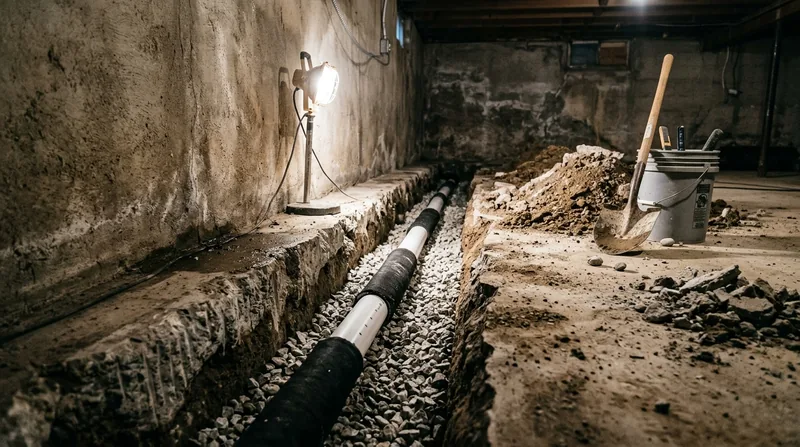




If you live in Jacobsville, Downtown Evansville, or one of the older east-side blocks, your basement was likely dug by hand into Ohio River silt and clay, and the footing drain that was supposed to protect it has long since silted shut. When spring rains hit and the river rises, that water has nowhere to go but through the mortar joints and up through the slab. An Interior Drain Tile System in Evansville captures that water at the footing before it reaches your floor, channels it to a sump basin, and pumps it out, and it works in any season, even when the ground is saturated. We install these systems for brick and stone foundations near Pigeon Creek and for poured-concrete walkout basements in the newer north-side subdivisions, and we tell you straight when simple crack sealing is enough and when hydrostatic pressure is the real problem. If you are still weighing your options, start with our basement waterproofing overview, then read on for how the interior system actually works.
Why Interior Drain Tile Matters in Evansville's River-Side and Clay-Soil Basements
Evansville sits on deep Ohio River silt and clay over glacial deposits, with loess silt on the uplands, and low lots near the river hold the water table close to the surface all year. Spring rains, heavy summer thunderstorms, and Ohio River flood stages push groundwater toward old foundations, and the 1937 flood still shapes how the riverfront is built. In 1890s to 1930s brick and stone basements, that means efflorescence, wall seepage, and water after rain, while 1970s to 2020s poured-concrete basements on the north and east edges crack at the cove joint and seep at the slab edge. Interior drain tile is the proven answer for both because it relieves hydrostatic pressure at the footing instead of fighting it at the wall surface.
- It captures water at the footing drain line before it can rise through the slab or the cove joint.
- It channels everything to a sump basin, where a sump pump with a check valve lifts it out and away from the foundation.
- It works through freeze-thaw swings and spring flood stages because the pipe sits below the frost line and below the slab.
- It installs in any season, so a wet basement in January does not have to wait for dry weather.
For homeowners in Newburgh, Boonville, and Mount Vernon dealing with the same clay soil and river-driven water table, the logic is identical, and the fix is the same.
Key info: On a 1920s brick basement in Jacobsville, we have seen a footer that sat only 14 inches below the slab, with the original weeping tile packed solid with silt. That is why seepage showed up every March along the same wall, and why an interior perimeter drain cut into the slab edge solved it where repeated parging had failed.
Permits for work that alters drainage or the sanitary connection of a sump discharge vary by jurisdiction, so always confirm the current rules with the City of Evansville building department before work begins.
How We Install an Interior Drain Tile System in Evansville, Step by Step
We start by walking the basement and the exterior grade, because the fix depends on where the water is actually entering. We look for efflorescence, musty basement smell, wall seepage after rain, and any sign that the water table is sitting high against the footing. From there we set a layout that follows the perimeter, keeps the pipe below the slab, and lands in a sump basin sized for the pump and the discharge line.
- We break and remove a 12 to 16 inch strip of slab along the perimeter wall and dig down to the footing.
- We clean the footing ledge and set perforated drain tile in washed gravel, with the holes facing down so water enters and silt stays out.
- We tie the perimeter run into a sump basin set at the low corner of the basement.
- We install a sump pump with a check valve and run the discharge line to a freeze-safe outlet away from the foundation.
- We cover the pipe with gravel, then a dimple board or vapor barrier against the wall to direct any wall seepage down into the drain.
- We pour new concrete over the trench and leave the floor ready for use.
Every run is tested with water before we close the trench, so you see the sump pump cycle and the discharge line flow before we call the job done.
Key info: On a 1950s brick bungalow in Oak Hill, the back wall seeped every time the ground thawed in February. We cut the perimeter trench, reset the footing drain in gravel, and tied it to a new sump basin with a battery backup, and the wall has stayed dry through three spring flood stages since.
If your existing drain tile is crushed or silted rather than missing, our drain tile repair and replacement service covers that scope, and the two often go together on older Evansville foundations.
| Approach | Description | Best for |
|---|---|---|
| Interior perimeter drain tile | Perforated pipe set at the footing inside the basement, gravel bed, tied to a sump basin and pump. | River-side homes and clay-soil basements with hydrostatic pressure and cove-joint seepage. |
| Interior drain tile plus dimple board | Drain tile with a dimple board or vapor barrier on the wall to direct wall seepage into the drain. | Brick and stone walls with efflorescence and damp wall surfaces above the cove joint. |
| Interior drain tile plus sump pump and battery backup | Full perimeter drain tied to a primary sump pump with a battery backup for power outages. | Homes that lose power during summer thunderstorms and spring flood stages. |
| Targeted crack injection before drain tile | Epoxy or polyurethane injection into active cracks, then interior drain tile for the perimeter. | Poured-concrete walls with a clear vertical crack plus general footing seepage. |
Interior Drain Tile System Cost in Evansville: What to Expect
Most interior drain tile work in Evansville starts around From $50 per linear foot, and that figure covers the trench, the perforated pipe, the gravel, the sump basin, and the concrete patch. The final number moves with the linear footage of wall, the depth of the footing, whether the slab is original 1920s concrete or a newer pour, and whether you add a sump pump, battery backup, or dimple board. A small 20-foot run on one wall is a different job from a full perimeter on a 1,200 square foot basement, and we price both honestly.
Getting two or three estimates is smart on any below-grade work, because the scope should match the water you actually have, not a one-size template. Ask each contractor to show the footage, the pipe type, the gravel depth, and the sump location in writing, and compare those line items rather than the bottom line alone. Our full pricing overview lays out how the numbers break down.
Interior Drain Tile System Near Me: How to Choose a Contractor Near Evansville
When you search for an interior drain tile system near me in Evansville, the first thing to confirm is licensed and insured status, because below-grade work involves concrete cutting, trenching, and electrical connections for the sump pump. Ask for the certificate of insurance before anyone breaks the slab, and confirm the license covers foundation and drainage work in Indiana. Get two or three written estimates with the same scope so you can compare them line for line, and ask for references from Evansville or Newburgh homeowners with the same foundation type as yours.
Ask who pulls the permit if the job alters drainage or the sanitary connection of the sump discharge, and confirm the local building department's current rules before work starts. If your home is in a subdivision with HOA requirements, check those before the trench is cut. You can reach us through our contact page to set up a free basement inspection and get a written scope for your Evansville home.
Interior Drain Tile System in Evansville: Pricing Guide
| Service | Price | Details |
|---|---|---|
| Interior perimeter drain tile | Starting at $50/linear ft | Includes trench, perforated pipe, gravel bed, sump basin tie-in, and concrete patch; footage and footing depth move the price. |
| Drain tile with dimple board | Starting at $58/linear ft | Adds dimple board or vapor barrier on the wall to direct wall seepage; brick and stone walls often need this. |
| Drain tile with sump pump and battery backup | Starting at $2,400 | Full perimeter run tied to a primary sump pump with battery backup; pump size and discharge line length affect the total. |
| Targeted crack injection before drain tile | Starting at $450 | Epoxy or polyurethane injection into active cracks before the perimeter drain goes in; crack length and wall thickness matter. |
| Complex or large-scale job | On estimate | Full-perimeter work on deep footings, walkout lots, or multiple wall types needs an on-site look before a number is given. |
| Travel | Included | in Evansville and surrounding areas, no separate call-out or mileage fee |
| Estimate | Free | Response within 24h at (812) 461-1167, no obligation to book |
Indicative pricing, the exact cost depends on square footage, finish, and site access. Free personalized estimate within 24h at (812) 461-1167.


